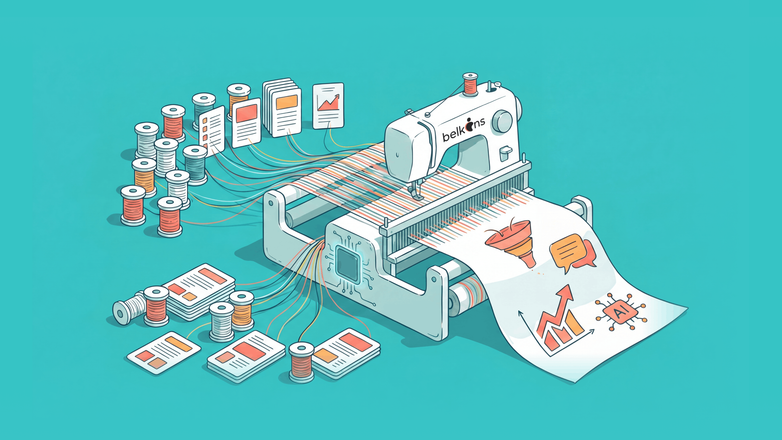
An AI SDR (AI sales development representative) is software that uses large language models to do the work of a human SDR: find target accounts, research contacts, write and send outreach, handle replies, and book meetings. The promise of swapping a salaried team for a subscription is hard to ignore.
In our 2026 study of 120 B2B sales professionals, roughly a third of respondents said they plan to replace their SDR team with AI eventually. Yet 35.4% of respondents in the same study said the vendor claim that AI “will eliminate the need for the SDR team” hasn’t matched what they’ve seen in practice.
At Belkins, we run outbound for B2B companies every day, and we see teams use AI in one of two ways:
- AI to cut costs. Teams replace the SDR salary with software, send the same generic sequence to more people, and hope volume makes up for relevance. This is what most “fire your SDR team” marketing sells.
- AI to reduce complexity. Teams use AI to do things no human team could do at a sane cost: read a prospect’s last 10 earnings-call mentions, cross-reference a new VP hire with a tech-stack change and a hiring spike, and write a message that only makes sense for that one account this week. Then they send fewer, better emails.
The first approach is a race to the bottom of an inbox that buyers already ignore. In a Gartner survey of 646 B2B buyers published in March 2026, 67% said they prefer a rep-free buying experience, up from 61% the year before. Generic outreach is losing ground whether a person or an AI writes it, because buyers can now research vendors without you.
The second approach is where AI earns its place, but a person still has to prioritize accounts and tailor messages, and then judge when a reply is a real opportunity. In a related Gartner survey, 69% of B2B buyers said they turn to sales reps to validate AI-generated insights.
That is the real problem with AI SDRs. They are fast at research and volume, but weak at judgment and at protecting your domain reputation. Most B2B teams get the best results from a hybrid model, where AI does the research and drafting, and people own targeting, quality control, and live conversations. Where exactly that line falls for your team depends on the task, which is exactly what I’ll discuss in this blog.
What an AI SDR actually does: task by task
The label “AI SDR” covers a wide range of products. As of September 2026, G2 lists 397 products in its AI SDR category, ranging from a single reply-handling agent to a fully autonomous platform. So instead of asking whether you should choose AI or a human SDR, it’s more useful to ask which tasks you should hand to AI and which ones you should keep with your people.
| SDR task |
What AI does well today |
Where a human is still needed |
Verdict |
| Account research |
Reads websites, job posts, funding news, filings, and tech stack in seconds; summarizes into a brief |
Judging whether a signal actually implies a pain your offer solves |
AI-ready, human spot-checks |
| List building |
Filters databases, enriches contacts, dedupes, finds lookalikes |
Defining the ICP, excluding customers, competitors, and sensitive accounts |
AI-ready with human rules |
| Copywriting |
Drafts personalized first lines and variants at scale |
Positioning, the core argument, tone for senior buyers, legal claims |
Hybrid |
| Sequencing |
Schedules steps, adjusts timing, pauses on replies |
Channel mix, volume caps per domain, when to stop |
Hybrid |
| Reply handling |
Classifies replies (interested, not now, wrong person, unsubscribe), drafts responses to simple questions |
Objections, pricing, pushback, anything a senior buyer writes by hand |
Human-needed for anything non-routine |
| Meeting booking |
Proposes times, sends calendar links, confirms |
Qualifying fit before booking, reminding and re-booking no-shows with context |
AI-ready for logistics, human for qualification |
| Cold calling |
AI voice agents exist, but consent rules are strict (see compliance below) |
Live conversation, gatekeepers, discovery |
Human-needed for outbound calls |
| Deliverability management |
Monitors bounces and some placement signals |
Domain strategy, warm-up, fixing blocklist and authentication problems |
Human-owned, tool-assisted |
What sales teams actually trust AI to do today follows this split closely. In our study, “AI-assisted with human review” was the most common answer for 10 of the 13 execution tasks we asked about, and fully autonomous use never passed 20% on any single task. Data enrichment came closest to full automation, with 20% of teams letting AI run it without review, followed by list building at 19%. At the other end, cold calling stays human-only for 55% of teams and objection handling for 57%. Even meeting scheduling, which the table above marks as AI-ready for logistics, is still handled only by people in 53% of teams.
I like to compare an AI SDR to a plane’s autopilot. It flies the long, predictable middle of the trip better than a tired human. But nobody lets autopilot choose the destination, handle the storm, or land in a crosswind without a pilot in the seat. In outbound, targeting is the takeoff, objections are the weather, and conversations with senior buyers are the landing.
AI SDR vs. human SDR vs. hybrid: how they compare on cost and results
Human SDR benchmarks come from The Bridge Group’s 2025 report (351 B2B companies, 83% SaaS). AI SDR prices come from vendors’ published pricing pages.
| Factor |
AI SDR (self-serve tool) |
Human SDR (in-house) |
Hybrid (AI + human oversight) |
| Cost structure |
Subscription, e.g., AiSDR $250 to $2,500/month, Salesforge Agent Frank from $499/month, plus domains, mailboxes, and data |
Median on-target earnings (OTE) $80K ($55K base, $25K variable), plus manager, tools, data, and benefits |
Tool and data costs plus fewer, more senior people; or one managed-service fee |
| Ramp |
Days to launch, but vendors and operators report weeks of training and review before results are stable |
Average 3.0 months to ramp |
Fast launch if the playbook already exists |
| Volume |
Thousands of contacts per month per workspace |
Median 112 activities per day across channels |
High volume where messaging is proven, low volume where accounts are high value |
| Meeting output |
Varies widely; see outcome data below |
Median quota of 10 meetings per month; only 60% of SDRs hit quota |
Depends on targeting and review quality |
| Message quality |
Consistent, but can be generic or factually wrong |
Uneven across reps, strong at nuance |
AI breadth, human judgment on what gets sent |
| Main risks |
Domain burn, hallucinated personalization, brand damage, compliance |
Turnover (average tenure 1.9 years), cost, inconsistent activity |
Coordination overhead; needs clear ownership |
| Best for |
Proven messages, inbound follow-up, re-engagement, long-tail segments |
Complex deals, enterprise accounts, calling-heavy outbound programs |
Most B2B teams selling to more than one segment |
📚 For cost per lead benchmarks by channel, see our B2B cost per lead guide.
Do AI SDRs work? What public and Belkins data show
The evidence below comes from both skeptics and vendors, and all of it is public, so you can check it yourself.
Adoption is early, and results lag. In November 2024, SaaStr surveyed its community: only 3% of respondents had closed revenue from AI SDRs, 11% were building some pipeline, and 83% had seen nothing yet. The Bridge Group’s 2025 report was the first to include AI SDRs as a category, at 1%.
Our own 2026 data points the same way. Our study looked at AI in lead generation more broadly than AI SDRs alone, and its sample leans toward small, tech-forward teams, but the pattern is hard to miss. Among the 96 respondents who actively use AI for lead generation, 53% started within the last six months, and “improved slightly” was the most common answer on every performance metric we measured. Most of them also can’t tell yet whether the investment pays off: 77% can’t confirm a positive return on investment (ROI), because 45% haven’t measured it and 32% say it’s too early to tell. The vendor claim that disappointed teams most was not a dramatic one. At 43.8%, it was the promise that the tool “requires no training or setup time.”
When the playbook exists, AI scales it. SaaStr later reported sending 60,000+ personalized emails and booking 130+ meetings with AI agents, with about a 6% response rate on the Artisan and Qualified platforms it used. Its lessons were telling:
- Train the agent on what already works with human SDRs.
- Segment contacts into batches of 800 to 1,000 by persona.
- Read every message the agent sends in the first 30 days.
- Keep 2 humans responsible for the agents: a vendor solutions architect and an internal go-to-market (GTM) engineer.
SaaStr founder Jason Lemkin puts it bluntly:
“If you feed an AI SDR a playbook that doesn’t convert, it will execute that bad playbook at scale.”
Vendor benchmarks look strong, but they are vendor benchmarks. AiSDR published data from 75 deployments showing reply rates rising from a 2.4% baseline to 6.8% at month three and 8.2% at month six. The company itself notes that these are operational metrics and don’t prove revenue ROI without deal-size and close-rate data. Treat any vendor’s numbers as a ceiling to test against rather than a forecast.
The cautionary tale: 11x. In March 2025, TechCrunch reported that 11x, one of the best-funded AI SDR startups, had displayed customer logos without permission. ZoomInfo said it ran a one-month trial and that the product “performed significantly worse than our SDR employees.” A former employee told TechCrunch the company was losing 70% to 80% of customers, while 11x countered that its retention rate was 79% and called the logo issues human error. Whatever the true number, the story shows the category’s main weakness: vendor demos run on clean data, but in production, the tool has to work with your customer relationship management (CRM) system as it really is, with duplicates and outdated records included.
Sellers are not feeling the lift yet. Gartner predicts that by 2028, AI agents will outnumber human sellers 10 to 1, yet fewer than 40% of sellers will report that agents improved their productivity.
Put together, the data suggests that AI SDRs work when they do specific jobs under human supervision, on top of a sales process that already converts. They rarely work as a replacement for figuring out who to sell to and why.
Where AI SDRs fail (and how to prevent it)
Most AI SDR failures start when a team switches on AI outreach before the process around it is ready. That matches what teams told us in our study, where generic or robotic output was the most common implementation challenge (37.5%), followed by poor data quality (31.3%). The good news is that each of the five risks below can be prevented, usually with a clear rule or a human checkpoint rather than a different tool.
1. Deliverability risk
AI makes sending cheap, so teams send more than their domains can carry. At the same time, mailbox providers have tightened the rules:
- Gmail treats anyone sending 5,000+ messages a day to Gmail accounts as a bulk sender and requires Sender Policy Framework (SPF), DomainKeys Identified Mail (DKIM), and Domain-based Message Authentication, Reporting, and Conformance (DMARC) alignment. It also asks senders to keep spam complaint rates below 0.1% and never reach 0.3%. Enforcement with temporary and permanent rejections ramped up in November 2025.
- Microsoft Outlook began rejecting non-compliant mail from senders of 5,000+ messages a day to consumer Outlook addresses on May 5, 2025, with the error “550; 5.7.515 Access denied.”
A 0.3% ceiling means 3 complaints per 1,000 emails. An AI SDR blasting a loosely targeted list can cross that in a single afternoon, and the damage hits every mailbox on the domain, including those of your account executives (AEs). Before you switch one on, run an email deliverability test and work through Folderly’s cold email deliverability checklist.
How to prevent it:
- Use separate sending domains and cap the volume per mailbox.
- Send only to verified lists.
- Make one person responsible for monitoring inbox placement.
2. Hallucinated personalization
Language models fill gaps with confident guesses. For example, “Congrats on the Series B” sent to a company that raised a Series A, or praise for a product line the prospect has shut down, reads worse than no personalization at all. Hallucinations were among the product complaints customers raised to TechCrunch in the 11x investigation.
How to prevent it: personalize only from sourced facts the tool can show you, and have a human review a sample of every new segment before the full send.
3. Compliance risk across multiple channels
Each outreach channel an AI SDR touches comes with its own rules, and in most cases, the liability stays with you rather than the vendor.
- Email: CAN-SPAM applies to B2B email with no exception. Every message needs accurate headers, an honest subject line, a valid postal address, and an opt-out honored within 10 business days. Penalties reach up to $53,088 per violating email, and you stay liable even if a vendor sends on your behalf.
- AI voice: On February 8, 2024, the FCC ruled that AI-generated voices are “artificial” under the Telephone Consumer Protection Act (TCPA), so calls using them to wireless or residential numbers need prior express consent. An AI cold caller dialing mobile numbers without consent is a legal risk rather than a growth hack.
- LinkedIn: LinkedIn’s User Agreement restricts bots and unauthorized automated methods, so aggressive AI automation can get the sender’s account restricted.
- Outside the US: The General Data Protection Regulation (GDPR), Canada’s Anti-Spam Legislation (CASL), and similar laws add consent and legitimate-interest rules. Get legal sign-off for each region.
4. Brand risk
Your prospects talk to each other, and a thousand mediocre, obviously automated emails can convince a market that your emails aren’t worth opening. Unlike a weak human rep, an AI SDR repeats the same mistake at full volume before anyone notices.
How to prevent it:
- Define the topics and claims the AI may never make.
- Exclude customers and accounts with open opportunities.
- Keep human replies from senior buyers.
5. Meeting quality vs. meeting volume
An AI SDR optimized for meetings booked will book meetings, but whether your AEs accept them is a separate question. Our study shows how wide that gap can get: SDR outreach volume improved for 66% of teams using AI, while deal-closing rate was the weakest metric, with 29% of teams reporting no change at all. That’s why calendar invites alone tell you little. Track these numbers instead:
- Meetings accepted by sales
- Show rate
- Meeting-to-opportunity conversion
Which AI SDR tools are on the market in 2026?
Details below come from each vendor’s own site or reputable press, checked in September 2026. We only list prices that vendors publish. This is not a ranking, since each tool fits a different job. For a broader list of services firms, see our guide to the best outsourced SDR companies.
| Tool |
Type |
What it does |
Published pricing |
| 11x (Alice, Julian) |
Autonomous AI SDR platform |
Alice runs outbound across email, phone, social, SMS, and WhatsApp with research, reply handling, and scheduling; Julian is an inbound AI phone agent |
Not published; demo required |
| Artisan (Ava) |
Autonomous AI business development representative (BDR) |
Ava finds leads, writes and sends outreach, handles replies, and books meetings; includes B2B data and AI dialer seats |
Not published; tiers scoped by volume (about 2,500 and 6,000 leads contacted per month on Team and Scale) |
| AiSDR |
Autonomous AI SDR |
AI-researched outreach over email, LinkedIn, and phone (via Aircall), with HubSpot and Salesforce integration |
Solo $250/month (200 contacts); Explore $900/month (800 contacts); Scale $2,500/month (2,500 contacts) |
| Salesforge Agent Frank |
AI SDR with autopilot or copilot mode |
Prospects, writes, and follows up over email and LinkedIn; copilot mode asks for approval before sending |
From $499/month for 1,000 active contacts (quarterly billing); sending infrastructure extra |
| Regie.ai |
AI sales engagement, human-in-the-loop |
AI agents handle list building, signal sorting, and email writing, then route high-value touches (calls, social) to human reps |
Not published on the sources we verified |
| Instantly |
Cold email platform with AI agents |
Sending at scale, warm-up, a lead database, plus an AI Sales Agent and AI Reply Agent |
Bundles published, from about $85 to $94/month (Starter) upward |
| Smartlead (SmartAgents) |
Cold email platform with AI agents |
Prompt-built agents that sync interested leads to the CRM, flag stale replies, and send performance alerts |
See Smartlead’s pricing page |
| Clay |
Data enrichment and AI research |
Pulls from many data providers and runs AI research steps to build and personalize lists; the research layer behind many AI SDR setups rather than a sender |
Free tier plus credit-based paid plans (restructured in March 2026) |
| Salesforce Agentforce SDR |
CRM-native AI SDR |
Automated outreach, lead qualification, and meeting booking inside Salesforce |
Not published on the page we reviewed |
| Qualified (Piper) |
Inbound AI SDR |
Engages website visitors, qualifies, and books meetings from inbound traffic |
Not published on the page we reviewed |
How to read this landscape. The tools split into three groups, and each asks something different of your team:
- Autonomous agents (11x, Artisan, AiSDR, Agent Frank) promise an end-to-end SDR.
- Sending platforms with AI features (Instantly, Smartlead) give you control but expect you to run the operation.
- Research and data layers (Clay) make personalization real but don’t send anything.
Most working stacks combine one tool from each group, plus a person who owns the result.
Decision framework: when an AI SDR is enough, and when you need humans
Use this table as a checklist. The more rows on the right describe your situation, the more you need people in the loop.
| An AI SDR alone is probably enough when... |
You need humans (or a hybrid partner) when... |
| You already have a message and ICP that convert with human SDRs |
You are still testing who buys and why |
| Deal sizes are small and the market is wide |
Average contract value is high, and each account is worth real research |
| You are following up inbound leads or re-engaging old ones |
You are breaking into cold enterprise accounts with buying committees |
| Buyers are comfortable with fast, short emails |
Buyers are senior, regulated, or relationship-driven |
| Someone internal can own tool setup, review, and deliverability |
Nobody has time to review output daily for the first 60 to 90 days |
| Email and LinkedIn are enough |
You need live cold calling or multi-language nuance |
| One bad email to a prospect is survivable |
One bad email to a target account could cost the deal |
Three quick tests before you buy an AI SDR tool:
- The playbook test. Can you name the segment, the pain, and the email that has already booked meetings? If not, AI will scale guessing.
- The owner test. Who reads the first 500 messages and every non-routine reply? If the answer is the AI, then stop.
- The domain test. If this tool burned your sending domain next week, what would it cost you? Your answer tells you how much deliverability oversight you need.
How to start with an AI SDR without putting your pipeline at risk
Before you sign with any vendor, run the three tests above against your current outbound program. If the playbook test fails, your first job is finding a message that books meetings with human SDRs, because AI can only scale a playbook that already exists. Once it does, use AI for the research and personalization no human team could afford, instead of sending more of the same email, and keep people in charge of targeting, messaging, replies, and deliverability.
If you want that hybrid model without building it yourself, book a strategy call with Belkins.