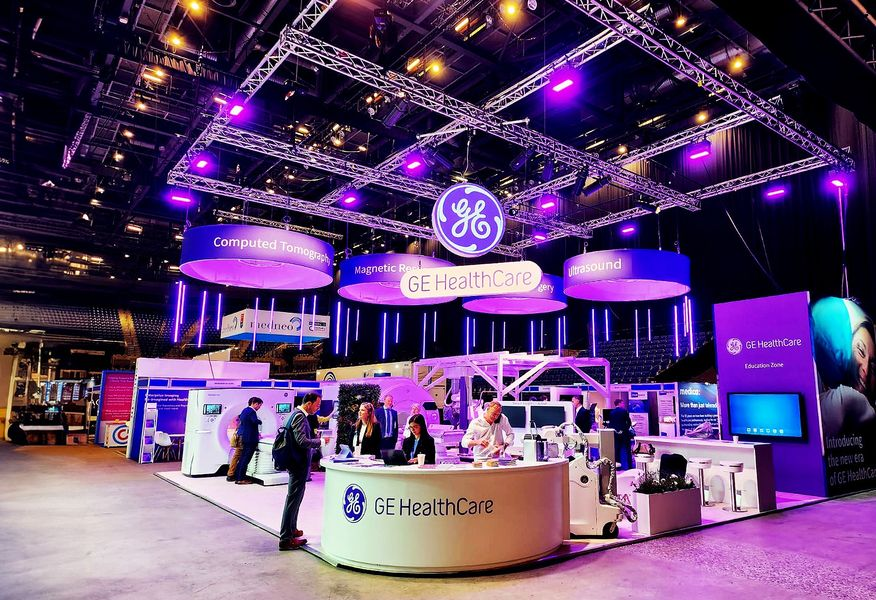
Impact of our partnership: 135 pre-booked meetings across 4 conferences
Over 7 months, GE HealthCare’s sales executives walked into four major medical conferences with their meeting calendars already booked. Belkins scheduled 135 in-person meetings with prospects from GE HealthCare’s target accounts, averaging almost 34 per event. That came in above the original commitment of 30 meetings at RSNA, and the program then expanded to three more conferences.
- 135 in-person meetings across RSNA, HIMSS U.S., HIMSS Europe, and ECR
- 112% average KPI across the program
- 4.2% to 13.8% lead-to-appointment conversion, depending on the conference
- 52 meetings from a single best-performing email sequence
- Sales-validated leads from top accounts added to GE HealthCare’s pipeline
- Under 2 weeks from planning to launch for the first campaign
Results by conference:
| Metric | HIMSS U.S. | HIMSS Europe | ECR | RSNA |
| Lead-to-appointment conversion | 13.8% | 7% | 4.2% | 9.1% |
| Reply rate | 18.75% | n/a | 6.94% | 16.28% |
| Share of replies that were positive | 32.5% | 54.8% | 61.2% | 65.9% |
Each conference had its own audience, attendee list, and lead time, which explains the spread in conversion. Two conditions worked in the campaign’s favor: GE HealthCare’s brand recognition, and the fact that prospects were already planning to attend. The outreach asked for 30 minutes at an event they were already going to, not a separate call.
Challenges: Strong account management, limited capacity for net-new accounts
GE HealthCare’s internal reps excelled at growing relationships with existing clients. Finding opportunities with net-new accounts was a different job, and the team didn’t have the resources to do both.
Conferences made this gap visible. GE HealthCare planned to showcase its Enterprise Imaging solutions at RSNA, the radiology industry’s major annual meeting, but time was short. Waiting for prospects to walk past the booth would have left the sales executives’ schedules to chance.
Why GE chose Belkins
Initially, they looked for someone to do cold calls on their behalf. We at Belkins noticed that and took a proactive approach, reached out to GE, and offered to discuss their needs.
As a global enterprise, GE had their own list of criteria the potential partner should meet. Even though they had other vendors on their list, they picked us because of:
- Proven track record. GE HealthCare highly valued our extensive experience in global campaigns, deep understanding of the healthcare industry, successful outreach campaigns in multiple languages, and ability to deliver, based on previous cases and client testimonials.
- Tailored strategic approach. They also liked the proactive aspect of offering personalized strategies and solutions to schedule more meetings.
- Quick rollout. They trusted our ability to plan, prepare, and launch campaigns in under 2 weeks, thanks to our well-tuned processes and skillful team.
- Transparency in commitment. This included realistic estimates, confirmed with each member of our team, and predictable outcomes, secured in the agreement.
“The partnership with Belkins was right what we needed to accelerate our lead generation efforts. Their approach has not only exceeded our expectations but has also provided us with a solid foundation for building lasting relationships with key decision-makers in the healthcare industry, including some of our strategic accounts. Special thanks for your dedication in managing every aspect of the campaign, from strategic planning to execution!”
— Pratyush Ghuwalewala, Senior Marketing Manager, Digital & Channels, GE HealthCare
Strategy and implementation: An event lead generation playbook
Every conference followed the same cycle: prepare, prioritize the attendee list, run outreach, protect the meetings already booked, and carry the lessons into the next event. Each campaign had only a few weeks between kickoff and the show, so every step ran to a fixed schedule.
Before outreach: Learning the product and securing the setup
Belkins held a series of calls with GE HealthCare’s team covering the product line, value proposition, go-to-market strategy, brand voice, ideal customer profile (ICP), and buyer personas. SDRs needed to answer prospects’ questions with confidence, since many replies came from senior radiology decision-makers.
Because the campaigns involved an enterprise client’s sensitive information, the team built a secure outreach infrastructure and tested every part of each campaign before launch.
Prioritizing the attendee list
Conference attendee lists are long, and most names on them weren’t the right prospects. Belkins and GE HealthCare’s sales team reviewed each list together and prioritized attendees from high-value accounts. This kept the outreach on the opportunities that mattered most and meant every booked meeting was worth a sales executive’s time at the booth.
The lists themselves included only names and company names. Belkins’ researchers added verified contact details and role information for each shortlisted attendee before outreach began.
Running conference-specific outreach
Each conference got its own email sequence, written for that event’s audience and for the key accounts expected to attend. Radiology decision-makers are hard to reach, so the team drew on its previous experience in the sector and ran A/B tests throughout, adjusting messaging as replies came in. The best-performing sequence produced 52 of the 135 meetings.

Protecting the meetings and recovering the rest
Booking a meeting was only half of the work at an event. Two follow-up tracks protected the results:
- A reminder campaign before each conference, to reduce no-shows and increase booth attendance
- A follow-up campaign for prospects who couldn’t meet in person, to schedule online appointments with GE HealthCare instead
Carrying results into the next event
After each conference, the team reviewed the campaign’s results and adjusted the next one to drive more conversions.
Working as an extension of GE HealthCare’s team
Belkins handled all pre-sales communication on GE HealthCare’s behalf. The team learned client’s internal processes, held regular sync-ups with its sales team, and added team members when the workload peaked before a show. Each lead was handed over with notes on why the prospect wanted to meet and what they wanted to discuss, so sales executives arrived at every meeting prepared.
Challenges Belkins encountered
- Short deadlines. Each conference left only a few weeks to set up and launch a campaign. The team set a fixed outreach timeline for every event and prepared each stage in full before launch, even under tight deadlines.
- Hard-to-reach decision-makers. Senior radiology leaders receive heavy vendor outreach, especially around major events. Ongoing A/B testing and messaging adjustments kept reply rates up.
- Thin attendee data. Raw attendee lists carried only names and companies, so the research work had to happen within each campaign’s short window.
- Enterprise security requirements. Working with a global healthcare company required a secure infrastructure and full testing before any outreach went out.
Lessons learned
- Pre-book the booth instead of waiting for traffic. Confirmed meetings let a sales team plan its time at an event around accounts it chose in advance.
- Prioritize the attendee list with the client’s sales team. The client knows which accounts matter. Shortlisting together kept outreach focused on those accounts.
- Write a separate campaign for every conference. Conversion ranged from 4.2% to 13.8% across the four events, so a single template would have underperformed at most of them.
- Plan for no-shows and absentees. Reminders protect booked meetings, and online follow-ups recover prospects who can’t come to the booth.
- This approach works for companies with a booth and sales executives at a major industry event, access to the attendee list, and at least a few weeks before the show. A company without an event presence, or one that can’t get an attendee list in time, would need a different way to reach the same buyers.